




Toenail Disorders
Toenail Disorders
Early care is best for toenail health. In their protective role, toenails bear the brunt of daily activities. Walking, running, wearing shoes or participating in sports are just a few of the stresses and strains the feet must endure.
All or a portion of the toenail plate can be damaged when the feet are injured or abused. Toenail problems are commonly caused by improper trimming, minor injuries or repeated trauma. Some toenail disorders can also be congenital. Proper trimming (along the contour) on a regular basis can help keep the toenails healthy, as can wearing well-fitted, low to moderately heeled shoes.
Ingrown toenail
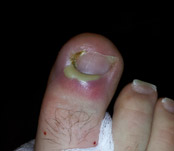
Painful ingrown toenails may be congenital, caused by an over-curvature of the toenail, or an imbalance between the width of the nail plate and the nail bed. Toe injuries that change the nail’s contour also can lead to an ingrown toenail. Toe deformities (such as a bunion that forces the big toe to lean toward the second toe), high-heeled or narrow pointed shoes can put pressure between the toenail and soft tissues, eventually forcing the toenail to grow into the skin.
Symptoms
Redness, swelling and infection make the toe very painful. Ingrown toenails can be accompanied by other toe disorders, such as excess surrounding tissue or an outgrowth of bone beneath the nail.
Treatments for the ingrown toenail
Surgery is often necessary to ease the pain and remove the offending toenail. Only a portion of the toenail may be removed. If the entire toenail is affected or there is a severe toenail deformity, then the toenail plate and matrix (the cells that grow the toenail) may be completely removed (see “surgical treatments for toenail disorders”)
Fungal infections
Various types of fungi are present everywhere in the environment. The dark, moist surroundings created by shoes and stockings make the feet especially susceptible to fungal infection. Most fungi are harmless until they penetrate the skin.
A fungus can invade through minor cuts, or after injury or repeated irritation to the toes causing the toenail to separate from the toenail bed. Fungal infections of the toenail plate and toenail matrix are quite common.
Symptoms
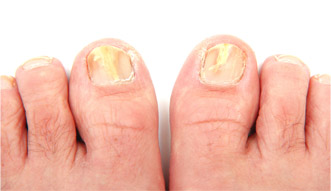
Fungus may cause the toenail to thicken and become yellow or brownish. As the fungus grows, foul-smelling, moist debris can be seen. Pressure from a thickened toenail or the build-up of debris may make the toe painful.
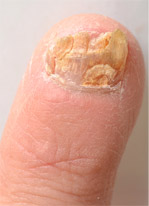
Treatments for fungal infections
Treatment is best begun at the early stages of infection. The accumulation of debris under the toenail plate can lead to an ingrown toenail, or to a more serious bacterial infection that can spread beyond the foot. To reduce pain associated with a thickened, infected nail, the podiatric foot and ankle surgeon may reduce its thickness by filing the toenail plate down with a surgical burr. Filing will not, however, prevent the infection from spreading. Oral and topical medications may be prescribed when:
- Only a small portion of one toenail is affected
- Several toenails are affected
- Keeping the toenail is desired
Medication may or may not completely eliminate the fungus. Often, after medication is discontinued, the fungus recurs. Your podiatric foot and ankle surgeon will monitor the results of oral prescriptions carefully and will explain any possible side effects. While topical ointments usually do not eliminate the fungus, they may be effective when used directly on the toenail bed, after the toenail plate has been removed. Eliminating the infection, in some cases, can only be achieved by permanent removal of the toenail plate (see “Surgical Treatments for Toenail Disorders”)
Blood beneath the toenail (hematoma)
A very common result of active lifestyles is blood, or a hematoma, beneath the toenail. Hematomas are especially common among people who job or play tennis, caused by the toes repeatedly rubbing against the shoe. A hematoma might indicate a fractured bone, especially after an injury (such as dropping a heavy object on the end of the toe). The toe should be examined by the podiatric foot and ankle surgeon who may take x-rays to determine the most appropriate treatment.
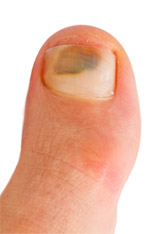
Hematoma treatments
If the hematoma is treated within the first few hours of forming, the podiatric foot and ankle surgeon will create a tiny hole in the toenail plate using a fine-point drill or scalpel. This releases the blood and relieves pain. If several days have passed and the blood clot becomes painful, the toenail plate may require removal so that the toenail bed can be cleaned. Some podiatric foot and ankle surgeons prefer to remove the toenail plate whenever blood forms beneath it, because the blood can attract fungi or bacteria and can lead to infection. The toenail may also be removed to treat a bone fracture beneath the hematoma. If the bone has fractured but has not moved out of its normal position, a splint may be used to keep the toe aligned during healing. Toenail plates that have been removed will grow again within three to six months.
Surgical treatments for toenail disorders
If the problem is severe or chronic, surgery to remove all or a portion of the toenail may be recommended. Most surgeries are performed very comfortably under local anesthesia and require less than one hour at the podiatric foot and ankle surgeon’s office. Laser surgery, because it requires special equipment, may be performed at a hospital. While these are some of the most commonly prescribed treatments for toenail disorders, others may be used. The podiatric foot and ankle surgeon will determine which treatment is likely to be the most successful in each case.
Partial toenail removal
For some cases of ingrown toenails, only the portion of the toenail that is growing into the skin is removed. If both sides of the toenail are ingrown, they may be removed during one procedure. After the affected portion of the toenail (one-eighth to one-quarter) is taken, the toenail bed is removed along with any enlarged tissue adjacent to the toenail plate. The toenail root and matrix are then destroyed by phenol, surgical removal or laser heat (see “permanent toenail removal”). Finally the skin may be remodeled around the toenail.
Permanent toenail removal
Complete removal of the toenail plate is a common remedy for fungal infections and ingrown toenails. During this procedure, the toenail plate is removed and the toenail matrix is destroyed by one of three methods:
- Phenol—an acidic chemical called phenol is applied only to the toenail matrix. This destroys the growth cells of the toenail.
- Surgical removal—the toenail matrix and bed is cut away. Stitches are only occasionally necessary.
- Laser—a form of burning in which laser heat is focused on the toenail matrix cells.
Removal of bone overgrowth
Bone directly beneath the toenail plate may become enlarged, developing a spur or outgrowth that can deform the toenail plate or lead to an ingrown toenail. Removal of excess bone may be performed concurrently with surgery to partially or permanently remove the toenail plate.
Care after surgery
Most people experience very little pain immediately following toenail surgery and during the healing process, which lasts about two to three weeks. If bone has been removed during surgery, a longer healing process should be anticipated.
Total toenail removal / partial toenail removal
The podiatric foot and ankle surgeon may prescribe medication for pain and may, but not always, advise that the toe be soaked two or three times daily for one week. Some amount of drainage is normal when the toenail has been removed chemically or by laser. If the toenail has been partially removed and stitches were used to form a new toenail fold, they are removed in approximately 10 days.
Ingrown toenail
Daily soaking in saline solution may be recommended. If the toe is inflamed or infected, a topical antibiotic is applied for three to seven days; if the infection is severe, an oral antibiotic may be prescribed. In very few cases, the infection may invade the bone beneath the toenail, requiring hospitalization and further treatment. The healing process generally does not interfere with daily activities.
Hematoma
Following simple drainage of a hematoma, the podiatric foot and ankle surgeon may advise that the toe be soaked and treated with topical antibiotics.
How will the toe look after surgery?
After surgery to permanently remove the toenail plate, the body generates a hardened skin covering over the sensitive nail bed. When this cover has developed, normal activities can be resumed. Women can also use nail polish on this area.
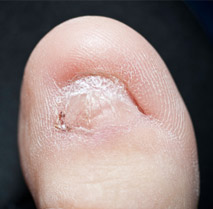
Will the toe nail re-grow after removal?
Partial growth of the toenail plate after permanent removal is rare, but possible. Because the toenail matrix has been destroyed, the toenail should not grow again.