




Ankle Sprains
Ankle Sprains
Ankle sprains are common injuries that occur when ligaments are stretched or torn. The ankle sprain is the most common athletic injury. Nearly 85% of ankle sprains occur laterally, or on the outside of the ankle joints. Sprains on the inside ligaments are less common.
Many sprains occur when participating in sports, or by twisting the ankle when walking on an uneven surface. Some individuals, due to their bone structure or foot type, are more prone to ankle sprains.

Anatomy of the ankle joint
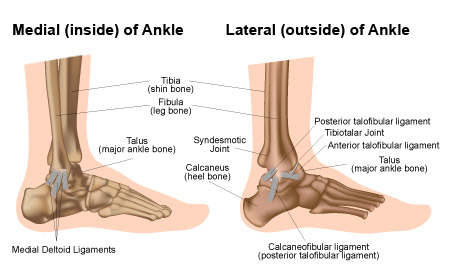
The ankle joint is made up of three bones. The bones are called the tibia, fibula, and talus. These bones form a socket in which the ankle joint moves.
The tibia, fibula, and talus are connected to each other by ligaments. Think of ligaments as thick rubber bands that hold bones together so that joints are stable and function properly. When an ankle is sprained, a ligament may be stretched, partially torn, or completely torn. Muscle and tendon structures the ligaments. These structures provide motion of the ankle joint for walking and running. Blood vessels, nerves, and skin overlie the ligaments and tendons. The ankle joint moves the foot upwards and downward. Just below the ankle joint is a ball and socket type joint that allows inward and outward motion.
Ankle injury symptoms
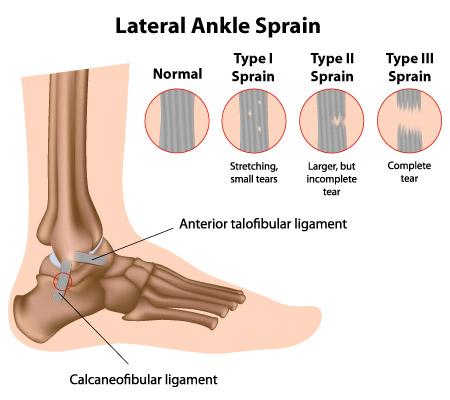
Ankle sprain symptoms vary depending on severity. Often, the ankle is tender, swollen, and discolored. The ankle can be quite painful to touch. Walking is usually hampered and may become difficult depending on the severity of the sprain. A feeling of instability may occur, especially in severe ankle sprains when ligaments are torn. Ankle sprains are classified by “types” and range from mild to moderate to severe. Classifying ankle sprains helps the podiatric foot and ankle surgeon diagnose the specific structures involved in the injury. This also helps determine appropriate treatment plans for each type of ankle sprain. Type I ankle sprain, the least severe, occurs when ligament fibers have been stretched or slightly torn. Type II sprains occur when some of these fibers are completely torn. Type III, the most severe, occurs when the entire ligament is torn and there is significant instability of the ankle joint. Fractures of the ankle or foot bones may be present. Fractures require immediate diagnosis and attention for appropriate treatment.
Diagnosis
The podiatric foot and ankle surgeon examines the ankle to identify the type of ankle sprain and determine the appropriate method of treatment. X-rays or specialized x-ray views of the ankle and foot may also be used to reveal and fractures, dislocations, or instability of the ankle joint. Less frequently, more sophisticated testing is necessary to examine soft tissue injuries. For example, computerized tomography (CT) and magnetic resonance imaging (MRI) give detailed views of the bone and soft tissue structures around the ankle joint. Once the diagnosis is made, the podiatric foot and ankle surgeon recommends appropriate therapy.
Treatments
Initial treatments include rest, ice, compression and elevation (RICE). The “RICE” method promotes healing, decreases pain and reduces swelling around the ankle joint. In more severe cases, non weight-bearing activities are encouraged and crutches may be recommended.
Rest
Ask your podiatric foot and ankle surgeon how long you should rest or restrict activity
Ice
Ice reduces swelling, bleeding, and pain following surgery
Compression
Dressings help reduce swelling and stabilize the joint, preventing unnecessary motion. Dressings should be snug but should not interfere with proper circulation
Elevation
Keep the foot at or above the level of the heart to drain excess fluids away from your foot. This helps to reduce swelling and discomfort
Compression may be achieved with an elastic bandage, splint, short leg cast, or brace, depending on severity. Compression eliminates motion around the ankle joint. The ability to walk or participate in other weight-bearing activities during the healing process depends on the severity or type of ankle sprain. This is determined by the podiatric foot and ankle surgeon once the diagnosis is made.
Most ankle sprains heal in 3-8 weeks. In more severe cases, ligaments may require more healing time to promote ankle stability. Repeated ankle sprains may cause chronic instability, interfering with walking or sports activities. In this case, the podiatric foot and ankle surgeon may recommend a surgical procedure to tighten or create new ligaments around the ankle joint to re-establish stability of the ankle joint.
Conservative treatment of many foot and ankle problems often promotes pain relief. For example, ankle strengthening exercises following the injury help prevent recurrence of injury. Most of these exercises can be done at home after appropriate instruction.
Ankle supports and braces or taping around the ankle joint is especially helpful for individuals participating in sports. Your podiatric foot and ankle surgeon may recommend preventive bracing to help prevent future injury.
Summary
The adage “it is better to break an ankle than sprain one” need not apply if the injury is appropriately diagnosed and treated by the podiatric foot and ankle surgeon.
Properly treated, the rehabilitated ankle can tolerate normal activities and the stress of participating in sports. The podiatric foot and ankle surgeon is a foot and ankle specialist who diagnoses foot and ankle conditions and determines appropriate treatment
While these are some of the most commonly prescribed treatments for ankle sprains, others may be used. The podiatric foot and ankle surgeon will determine which treatment is likely to be the most successful in each case.