




Ankle Fractures
Ankle Fractures
Ankle fractures, otherwise known as a broken ankle, indicate an injury to one of the bones that make up the ankle joint. This type of injury can range from a simple break in the bone that does not require extensive treatment, to a complex injury requiring surgical management and no walking on it for months.
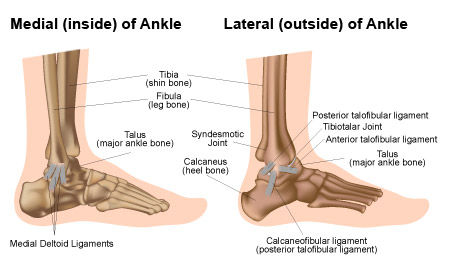
The anatomy of an ankle fracture is complex with many involved structures:
- 3 bones
- Tibia (leg bone)
- Fibular (outside leg bone)
- Talus (foot bone)
- 2 sets of ligament
- Medial deltoid ligaments
- Inside part of ankle
- Lateral collateral ligaments
- Outside part of ankle
- Medial deltoid ligaments
- 2 involved joints
- Tibiotalar joint
- Between the leg bone and foot bone
- Syndesmotic joint
- Between the tibia and fibula
- Tibiotalar joint
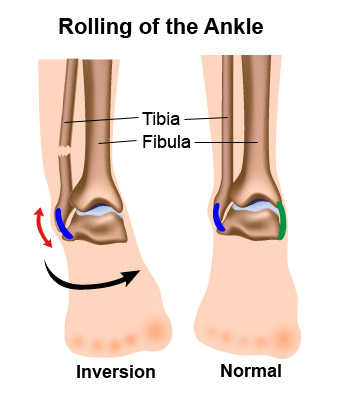
The most common cause of an ankle fracture is “rolling of the ankle” causing a break in the outside bone (fibula) and inside bone (tibia) of the ankle. This type of injury can also cause an injury to one of the ligaments that support the inside and outside part of the ankle. Ankle fractures are becoming more prevalent in our society due to the aging population. Common complaints from patients with a broken ankle include pain, swelling, bruising, blistering, and an inability to put weight on the affected leg. Sometimes, however, a patient is able to walk on a broken ankle. Therefore, timely and accurate diagnosis of this injury is critical to proper treatment.
Diagnosis of this condition is typically made with a physical examination and x-ray evaluation by your podiatric physician. Your doctor may also take a specific type of x-ray called a stress x-ray. This will evaluate the stability of the ligaments around the ankle and the possible need for surgery. Your podiatrist may also order a CT scan for further evaluation of the ankle bones.
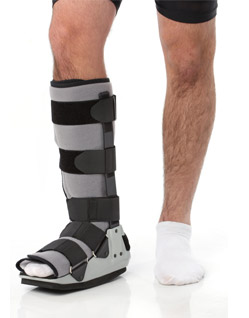
Treatment of ankle fractures injuries range from simply casting the ankle in a short leg cast or walking boot, to surgical management and fixation of the injuries. There are many factors that help to determine the appropriate treatment of these injuries. Some of the factors that help determine the treatment necessary include:
- How many bones of the ankle are involved (fibula, tibia, back of the tibia)?
- Is there an associated ligament injury?
- Is there instability as determined by the stress x-ray?
- General health of the patient?
- Is the patient diabetic?
- Is there an injury to the ligament that holds the tibia and fibular together (syndesmosis injury)?